Integrating the Bee Shadow Box 3D Svg into Your Creative Workflow
The intersection of digital design and physical crafting has evolved significantly, moving beyond simple templates into complex, multi-layered projects that require precision and planning. For creators, educators, and small business owners looking to add a tactile dimension to their output, the Bee Shadow Box 3D Svg offers a structured approach to achieving professional-grade results. This digital asset is not merely a static image; it is a comprehensive file set designed to facilitate the creation of intricate, layered paper art using modern cutting machines like the Cricut Maker 3.
Understanding how this product fits into your broader workflow requires shifting the perspective from "buying a craft" to "acquiring a production tool." The value lies in the organization of the layers, the compatibility of the formats, and the efficiency gained by having pre-structured files ready for immediate execution. Whether you are preparing classroom materials, creating unique home decor items, or producing merchandise for an online store, integrating this SVG bundle into your process can streamline operations and enhance the final quality of your work.
Technical Specifications and File Compatibility
Before diving into the creative application, it is essential to understand the technical foundation of the product. The Bee Shadow Box 3D Svg is delivered as a digital download, meaning there is no physical shipment involved. Instead, you receive immediate access to four distinct file formats: SVG, DXF, PDF, and EPS. This multi-format delivery is critical for interoperability across different software ecosystems and hardware platforms.
- SVG (Scalable Vector Graphics): Ideal for use with Cricut Design Space, Silhouette Studio, and other vector-based cutting software. This format allows for easy scaling without loss of quality.
- DXF: A widely supported drawing exchange format, often used in CAD applications and compatible with many older or specialized cutting machine software suites.
- PDF: Useful for printing reference guides or for users who prefer to manually trace or cut designs if they do not have a direct-to-machine workflow.
- EPS: Essential for professional graphic designers who need to import the vectors into Adobe Illustrator or InDesign for further customization before sending to a cutter.
The specification notes compatibility with all cutters on the market. However, the mention of the Cricut Maker 3 highlights that the file structure is optimized for high-precision machines capable of handling fine details and multiple passes. While the files work with any cutter, understanding the capabilities of your specific machine will help you adjust blade depth and pressure settings to ensure clean cuts, especially when working with thicker cardstocks.
Structural Integrity and Layer Management
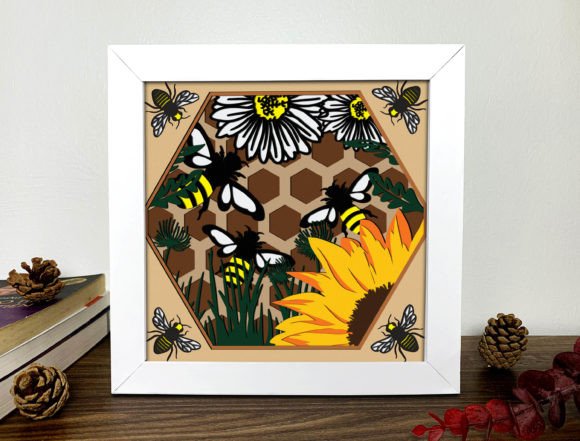
A shadow box project differs fundamentally from a single-layer decal or sticker. The Bee Shadow Box 3D Svg consists of 14 distinct layers. In a digital workflow, layer management is where most errors occur. If layers are not named correctly or grouped properly in your design software, the cutting sequence may become chaotic, leading to misaligned pieces and wasted material.
When you open the files in your preferred software, you should observe a well-organized hierarchy. Each layer corresponds to a specific depth plane in the final 3D assembly. The complexity of 14 layers means that attention to detail during the preparation phase is non-negotiable. It is recommended to keep the layers grouped exactly as they appear in the source file until you are ready to send them to the cutting bed. This preserves the intended spatial relationship between the bee’s anatomy and the background elements.
The dimensions provided are 20x20cm (7.8x7.8in). This size is versatile enough for desktop displays, small wall art, or gift tags, but large enough to showcase the intricate details of the bee design. When scaling the design, remember that while the SVG is scalable, the physical limitations of your cutting mat and blade radius must be considered. Very small internal details may require a finer point blade and slower cutting speeds to prevent tearing.
Material Selection and Preparation
One of the significant advantages of this digital product is its adaptability to various materials. While the default assumption might be standard white cardstock, the instructions explicitly encourage the use of paper of different colors depending on user preferences. This flexibility allows for extensive customization based on branding, seasonal themes, or personal aesthetic choices.
For a true 3D effect, contrast is key. Using darker papers for the background layers and lighter, more vibrant papers for the foreground bee elements can create depth. Alternatively, using monochromatic shades of yellow and black can produce a sophisticated, modern look. When selecting paper, consider the weight. Standard 80-100 GSM paper may be too flimsy for a stable shadow box, potentially causing layers to sag. Cardstock ranging from 180 GSM to 250 GSM provides the necessary rigidity to hold the 3D structure together once glued.
Preparation also involves organizing your workspace. With 14 layers, you will likely have dozens of individual pieces. Implementing a sorting system immediately after cutting is crucial. Labeling each stack according to its layer number or color ensures that the assembly phase does not become a puzzle-solving exercise under time pressure.
Integration into Business and Educational Workflows
For entrepreneurs and educators, the Bee Shadow Box 3D Svg serves as a scalable resource. In an educational setting, this project can be broken down into modules. Younger students might focus on the coloring and basic assembly, while older students can engage with the digital file manipulation, learning about vector graphics, layering, and precision cutting. The inclusion of PDF files allows teachers to provide printed instructions alongside the digital files, bridging the gap between screen-based learning and hands-on application.
For small business owners, particularly those in the handmade goods sector, this product reduces the R&D time associated with designing new products. Instead of spending hours drafting the geometry of a bee and testing its structural integrity, you can leverage the existing 14-layer structure. You can then focus your energy on marketing, packaging, and customer engagement. By offering customizable color options, you can cater to niche markets, such as spring-themed events, nature conservation fundraisers, or educational science kits.
Marketers and bloggers can utilize the visual appeal of the finished shadow box for content creation. The process of assembling the 14 layers makes for engaging video content, demonstrating the "behind-the-scenes" effort that goes into handmade products. This transparency builds trust with audiences who value craftsmanship and detailed execution.
Assembly and Quality Control
The transition from digital file to physical object involves several stages of quality control. After cutting, inspect each piece for burrs or incomplete cuts. Even with a sharp blade and correct settings, minor imperfections can occur, particularly with intricate parts like the bee’s wings or antennae. Use a precision knife to clean up any rough edges before proceeding to assembly.
Assembly requires patience. The 3D effect is achieved by spacing the layers apart, typically using foam tape or spacers between the backing board and each subsequent layer. Start from the back layer and work forward. Ensure that each layer is centered and aligned perfectly before adhering it. Misalignment at an early stage compounds with every subsequent layer, resulting in a skewed final image. Taking the time to verify alignment at each step saves significant rework later.
Consider the lighting conditions where the shadow box will be displayed. The interplay of light and shadow enhances the 3D effect. Natural light or directed spotlights can accentuate the depth created by the 14 layers. This consideration is part of the broader implementation strategy—thinking about the end-user experience and how the product will be perceived in its final environment.
Long-Term Value and Adaptability
Digital assets offer long-term utility that physical products cannot match. Once purchased, the Bee Shadow Box 3D Svg files remain in your library indefinitely. You can revisit the project years later, experiment with new color palettes, or integrate the bee motif into larger composite designs. The EPS and DXF formats ensure that even if your primary software changes, you retain the ability to edit and use the core geometry.
This permanence supports sustainable creative practices. Rather than buying disposable craft kits, you invest in a reusable toolkit. You can print only what you need, when you need it, reducing waste. Furthermore, the ability to tweak the design means you can maintain consistency with your brand guidelines over time, adjusting colors or sizes without losing the core identity of the project.
In conclusion, the Bee Shadow Box 3D Svg is more than a simple craft template; it is a component of a efficient, scalable creative workflow. By understanding its technical specifications, managing its 14 layers with precision, selecting appropriate materials, and integrating it thoughtfully into your business or educational processes, you can achieve high-quality results consistently. The key to success lies in treating the digital file as a blueprint for production, applying rigorous preparation and quality control measures at every stage of the journey from screen to shelf.